
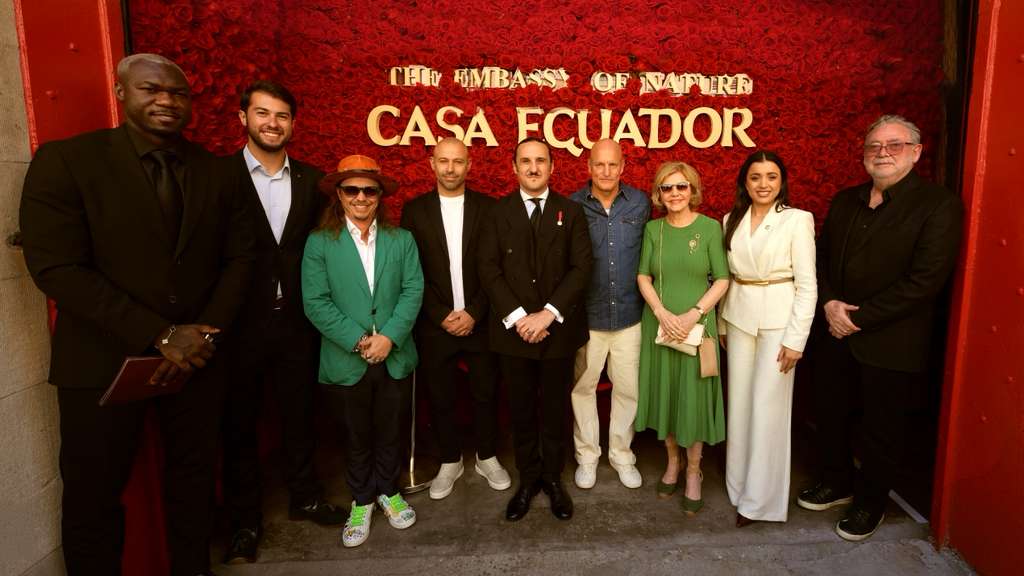
For most of his life, Luis Felipe Fernández-Salvador y Campodónico, Sixth Marquis of Lises (Kingdom of Spain), pursued the kinds of ambitions more commonly associated with another era.
Explorer.
Filmmaker.
Entrepreneur.
Institution builder.
For decades, he crossed remote Amazonian territories searching for the lost treasure of Atahualpa, produced internationally recognized films, restored historic landmarks and built ventures across multiple industries.
Yet the project that has brought him to Manhattan during FIFA World Cup week may prove to be his most ambitious.
Not because it looks backward.
But because it attempts to answer a question about the future.
What if nature could compete for capital?
That question sits at the center of TEON — The Embassy of Nature, an international institution founded by Fernández-Salvador and first presented during the United Nations High-Level Week in 2024.
Last week, TEON brought that vision to New York through Casa Ecuador, one of several international platforms being developed under its model of functional governance to transform nature, culture, identity and heritage into instruments of influence, investment attraction and long-term prosperity.
Located in Manhattan during the FIFA World Cup, Casa Ecuador was conceived not as a traditional national pavilion, but as an immersive world inspired by Ecuador’s Coast, Andes, Amazon and Galápagos.
Bringing together art, gastronomy, business, diplomacy, storytelling and sensory experiences, the platform was designed to feel closer to a motion picture than a conventional exhibition.
Developed in collaboration with internationally recognized creatives, including Academy Award-winning talent associated with TEON’s broader cultural ecosystem, the experience seeks to demonstrate how culture, identity and storytelling can become strategic assets for nations in the twenty-first century.
According to TEON, this approach forms part of a broader philosophy known as Cultural Capitalism.
Through Cultural Capitalism, TEON seeks to help nations transform culture, identity, heritage and creativity into strategic assets capable of generating influence, investment attraction, opportunity and international relevance.
The same philosophy is now guiding the development of Casa USA, a future platform dedicated to presenting America’s cultural, historical and natural wealth through a new form of experiential diplomacy.
The project seeks to showcase the assets that have shaped the American story while strengthening cultural exchange, investment attraction and international engagement.
Yet behind the cultural experience lies a larger economic ambition.
TEON confirmed that it is currently executing a multi-year Environmental Capitalism agenda and is working under an active mandate with one of the world’s leading Big Four professional services firms as part of a confidential implementation phase expected to conclude later this year.
The initiative is based on a premise rarely discussed within traditional finance.
For centuries, capital has overwhelmingly flowed toward activities that extract value from nature.
TEON’s objective is to create structures through which nature can compete for capital without requiring its destruction.
This is not a digital asset initiative.
It is not a tokenization project.
It is not a cryptocurrency.
And it is not a carbon-credit platform.
According to the institution, the framework is being developed within traditional capital markets and sovereign finance.
The first phase is being structured for sovereign entities and institutional participants. Future phases are expected to broaden access through traditional capital-market structures following the completion of the current implementation phase.
TEON believes that some of the most important financial innovations of the coming decades may emerge not from redefining technology, but from redefining what financial systems are prepared to recognize as value.
“We are not asking markets to make sacrifices for nature,” Fernández-Salvador said.
“We are working to create structures through which nature can compete for capital.”
That proposition may sound unusual.
Yet TEON argues that modern economies continue to undervalue some of the most important assets they possess: biodiversity, natural heritage, cultural identity and the living systems upon which all economic activity ultimately depends.
The institution’s objective is not to create charitable instruments for nature.
Its objective is to create market-driven structures capable of competing alongside traditional asset classes. When implemented, the implications could extend well beyond environmental policy.
They could influence how nations think about wealth itself.
And that conversation begins this week in Manhattan beneath a name that has already started attracting curiosity from diplomats, investors, entrepreneurs, artists and policymakers alike:
The Embassy of Nature (TEON).
ABOUT TEON — THE EMBASSY OF NATURE
TEON (The Embassy of Nature) is an international institution operating under the principles of functional governance, founded by Luis Felipe Fernández-Salvador and first presented during the United Nations High-Level Week in 2024.
Created to advance the political, economic and diplomatic representation of nature through a decentralized global framework, TEON promotes the recognition of nature as a subject of rights while developing new models of Environmental Capitalism and Cultural Capitalism designed to help nations strengthen their natural sovereignty, attract investment and participate competitively in global markets through the preservation and responsible valuation of their natural assets.
Through initiatives such as Casa Ecuador, Casa USA and Casa España, TEON develops cultural, economic and diplomatic platforms that seek to transform nature, identity and heritage into strategic assets of international influence, cooperation and long-term prosperity.